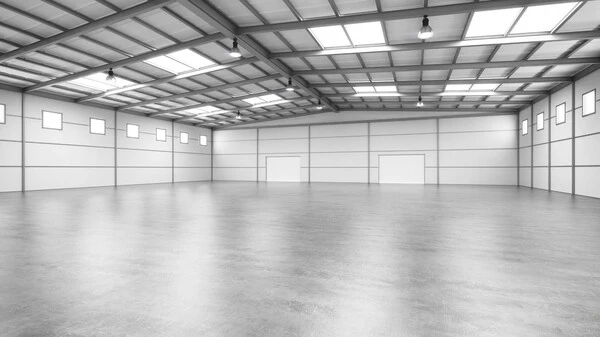
Concrete floors are known for their flatness and levelness, making them suitable for spaces where precision is important. Commonly used in warehouses, distribution centers, and factories, these superflat concrete floors support efficient operation of material handling equipment and automated systems. Achieving this flatness requires careful planning and execution, often with the use of specialised techniques and technology.
What Is a Superflat Floor?
A superflat floor is built to tighter tolerances than a regular floor slab. To create one, manufacturers use the Fmin tolerance system, which sets the maximum variation for a specific lift truck.
This system makes sure the floor is flat and level enough for the needs of high-speed material handling equipment. This precision reduces the chance of errors and damage during operations, supporting the smooth and safe movement of goods in the facility.
Multiple Benefits from Optimisation of a Surface
- Optimizing the lift truck’s performance.
- Reducing maintenance-related costs.
- Eliminating the chance of picking problems, including rack impact.
Facts to Keep in Mind When Specifying and Designing Superflat Floors
- Strip pouring techniques are important in high-rack, narrow-aisle areas where automatic guided vehicles (AGVs) work. Without these techniques, it’s hard to meet the required transverse and longitudinal tolerances.
- Superflat floors should not have transverse saw cuts. These joints can cause shrinkage and curling, leading to tolerance issues that can make superflat floors unusable.
- Floor tolerances need to be checked daily. Daily measurements with sensitive profiling equipment are important. Without regular checks, construction defects can worsen, and surface quality cannot be certified without proper measurements.
- Fmin tolerances apply only to floors with defined traffic. The FF/FL F-number tolerance system is meant for surfaces with specific traffic, not for equipment tolerances needed in random traffic scenarios.
- Ensure the continuous steel embedded in the concrete is placed correctly. The positioning of embedded steel should not interfere with guidewire signals. Steel fibers can meet different user needs effectively.
- Some dry-shake hardeners may not work well. Certain hardeners can prevent achieving superflat tolerances. Good surface solutions usually rely on a concrete mix with a maximum water-to-cement (w/c) ratio of 0.50 and a suitable liquid densifier, which should be chosen based on the specific environment.
Superflat Floor Tolerances
- Random-traffic: Most floors in the country fall into this category, where pedestrian and forklift traffic can move freely in any direction.
- Defined-traffic: These floors are used for specific applications, like VNA (very narrow aisle) warehouses, where forklifts follow the same path each day. Although defined-traffic floors make up a small percentage of U.S. floors, their use is growing as more owners see their benefits.

In VNA warehouses, forklifts navigate 6-foot-wide aisles between storage racks using either a guidance system in the floor or rails mounted on the racks. With lift trucks about 5 feet wide and 7 feet long, they can raise their forks to place or pick up products at different levels. For good performance, defined-traffic floors need to be very flat.
Superflat Vs. Random-Traffic Tolerances
For contractors to build a superflat floor, it is important to specify the floor correctly. A common mistake is calling for random-traffic tolerances instead of the required superflat tolerances. This often comes from a lack of understanding or an attempt to save money.
Unfortunately, there is little information available for those writing superflat floor specifications. The American Concrete Institute and ASTM standards provide limited guidance on this topic, leading to confusion.
Manufacturers of lift trucks do suggest specific floor tolerances to ensure their equipment works well. Unlike random-traffic floors, which have FF/FL requirements, superflat floors require a minimum tolerance written using the Fmin system.
Fmin Tolerance Requirements
The Fmin system measures and defines tolerances, requiring defects beyond the allowed variation to be fixed by grinding them down. The Fmin tolerance for any floor surface is based on the maximum allowed change per foot for a lift truck moving in a straight line. You should check with your lift truck manufacturer for this information. Here are some common Fmin tolerances:
- 0.040 inches: Fmin100
- 0.050 inches: Fmin80
- 0.060 inches: Fmin65
- 0.070 inches: Fmin55
- 0.080 inches: Fmin50
A higher Fmin tolerance means a flatter and more level floor. Fmin100 is the most common tolerance, while Fmin50 is the lowest. Since lift trucks travel the same path repeatedly, the smoothness of these paths is important.
Superflat slabs are placed in narrow strips about 15 feet wide. Confirm the tolerance of the wheel tracks in both directions. The superflat Fmin100 tolerance is based on a change of 1/8 inch in height over a 10-foot level plane. Wheels on VNA lift trucks are typically 5 feet apart, needing a 1/16-inch change in height. The tolerance adjusts based on the lift truck’s dimensions.
Common Specifications Errors
Forgetting Random-Traffic Floor Specifications
Contractors should keep in mind that superflat floor specifications often involve random-traffic considerations. Superflat slabs are not completely flat, and tolerances are only checked in the wheel tracks in one direction.
Meeting the Fmin100 (defined-traffic) tolerance in all directions can be tough and similar to hitting FF140/FL100 (random-traffic) tolerances. The challenge increases with construction joints.
For example, television studios need these specs, but they are often over-specified. Ideally, random-traffic floors should have a maximum tolerance of FF70/FL50.
Considering F-100 and Fmin100 as the Same
Specifiers and contractors need to understand that F-100 and Fmin100 are different. Building an F-100 floor is more complex, and even if a contractor succeeds, it may not meet the owner’s needs.
Some contractors choose a lower random-traffic tolerance instead of Fmin100 to save money, which can lead to problems. A better way is to create a floor that meets a lower defined-traffic tolerance.
Complicating Costs
Some VNA lift trucks can work well on surfaces below Fm100. In the early days of superflat floor construction, costs and methods were similar across all superflat floors, meaning a Fmin100 floor did not cost more than a Fmin60 floor.
As contractors learned more, they improved their techniques to create lower-tolerance superflat floors at lower costs. Before bidding on a project, contractors should understand how superflat surface tolerances are set and the equipment used for measurement.
Confirming Extraneous Tolerances
Only the wheel track area of Fmin specifications needs confirmation. In contrast, the tolerance of a random-traffic floor is based on statistical data and random measurements, which do not show how well a lift truck will work on a defined-traffic path.
Superflat Floor Applications
Superflat floors are used in many applications, such as:
- Office buildings
- Stadiums
- Gymnasiums
- Ice rinks
- Production studios for camera dollies
- Distribution and warehousing centers with air-pallets
The needs for superflat floor concreting can differ based on your application. Dynamic Concrete Pumping has a team that focuses on superflat floor construction. We use modern equipment like the Somero Laser Screed and the 12-foot-wide Whiteman power trowels, allowing us to pour almost 80,000 square feet in a single day.
You might also want an environmentally friendly company that prioritizes environmental standards. From our eco-friendly hydraulic fluid to our concrete reclaimers, we aim to find solutions that are kind to the environment. This may be important for your company.
Confirming Superflat Tolerances
To measure random-traffic floors accurately, several instruments are available. However, these tools should not be used for defined-traffic floors. For defined-traffic floors, it’s important to measure each traffic path directly with a continuous-recording floor profilometer that follows the wheel tracks.
As the profilometer moves along the path, it records differences in elevation. The results do not provide F-numbers but show whether the surface meets minimum requirements. The profilometer generates a tape to indicate if the surface is “in tolerance” and highlights any defects so the contractor can fix them.
Attempts to measure defined-traffic surfaces with equipment designed for random-traffic surfaces usually do not work well. This is because the equipment needs to measure information from each wheel track separately, leading to errors.
The farther the measuring equipment moves from the starting point, the more errors can happen. Using a continuous recording profilometer helps reduce mistakes because it measures elevation changes as it rolls along the path.
Other Considerations to Keep in Mind
The Location and Intended Use
Consider where your flooring will be placed. For areas with regular traffic, like shopping centers or hospitals, a standard slab may work well. If the space has narrow aisles or Very Narrow Aisle (VNA) trucks, a flat concrete floor is likely needed.

Floor Flatness Standards
Flat floors have specific requirements for flatness. If you choose a flat floor, be aware of these standards before and after construction.
Construction Requirements
As mentioned, a flat floor requires particular installation standards. If you opt for a flat floor, the construction process will differ. Hold meetings with engineers, concrete manufacturers, suppliers, and other key members of the installation team. They can help assess your site and ensure you meet the requirements.
Corrective Grinding
Creating a flat floor without flaws is not possible. Superflat specifications should allow for the use of grinders to fix areas that don’t meet standards. However, grinding should be minimal and mainly done in the wheel paths of lift trucks. Some specifications allow for a maximum of 15% grinding, based on aisle lengths, not individual tracks.
Typically, the average grinding is between 3% and 5%, with skilled contractors grinding under 2%. The amount of grinding needed also depends on working conditions and the quality of concrete.
Areas requiring floor grinding are usually small and may only need removal of 0.010 to 0.020 inches. These small imperfections can be easily spotted with the right measuring tools.
Contractors can prevent confusion if specifications are written and understood. Both the contractor and the specifier should know the procedures and standards. No matter how skilled they are, meeting expectations is not possible if those expectations are wrong.
Want to Hire a Professional Contractor? Contact Us Today!
Ensure your project succeeds by hiring skilled professionals who know the details of superflat floor installation. Our team is ready to help you achieve high standards of floor flatness with accuracy and efficiency.
Contact us today to discuss your project needs and find out how we can help you create a superflat floor that meets your specifications. Don’t settle for less—let us provide a flooring solution that ensures good performance and durability. Reach out now to begin your superflat floor project!
FAQs
Is flat slab expensive?
Flat slabs can be more expensive because of the careful construction process and higher standards needed. The cost depends on factors like area size, materials, and flatness needs. Investing in a flat slab can bring long-term benefits, such as better efficiency and lower maintenance costs, making it a good choice for places that require a high level of floor flatness.
What are the requirements for a super flat floor?
Superflat floors must meet strict flatness and levelness criteria. These standards are defined by floor flatness (FF) and floor levelness (FL) measurements. The FF number shows flatness over a short distance, while the FL number shows levelness over a longer distance. For a superflat floor, FF and FL numbers are higher than those for standard floors, ensuring small height differences and smooth surfaces.
Superflat floors often need special concreting methods, laser-guided tools, and constant monitoring during construction to achieve the right flatness. The installation may also require careful planning of concrete placements, controlled drying conditions, and regular inspections to meet these standards.
How much weight can a flat floor hold?
The weight a flat floor can hold depends on several factors, such as the slab thickness, the type of concrete, and the presence of reinforcing materials like rebar or steel mesh. Standard concrete floors usually support a load of 1,500 to 3,000 pounds per square inch (psi).
However, floors designed for heavy machinery or busy areas can hold much more weight. It’s important to talk to structural engineers and concrete specialists to find out the load capacity you need and to ensure compliance with local building codes and safety standards.
Which floor flat is better?
Choosing the right floor flat depends on your specific needs. For typical warehousing or industrial operations where precision isn’t critical, a standard floor may be enough. However, if you’re using very narrow aisle (VNA) trucks or automated systems, a superflat floor is often necessary.
These floors keep elevation differences to a minimum, helping to avoid issues in precise environments. Your choice should also consider budget, intended use, and maintenance plans. It’s important to consult with flooring experts and assess your operational needs to make a good decision.
Which floor flat is most expensive?
Superflat floors are usually the most expensive type of flat floors. This higher cost comes from the precise construction needed, the use of advanced tools like laser-guided screeding, and the ongoing checks to meet strict flatness and levelness standards.
The choice of materials and the skill of the contractors also add to the expense. While superflat floors require a larger initial investment, they provide long-term benefits in settings that need very low tolerances for height differences and surface bumps, making them a smart choice for certain industrial and commercial uses.